Steam Heat & Radiator Repair in Fordham Bronx
Methodical troubleshooting for noisy clanging steam pipes, cold cast-iron radiators, spitting air vents, and leaking shut-off valves across Fordham, Bronx.
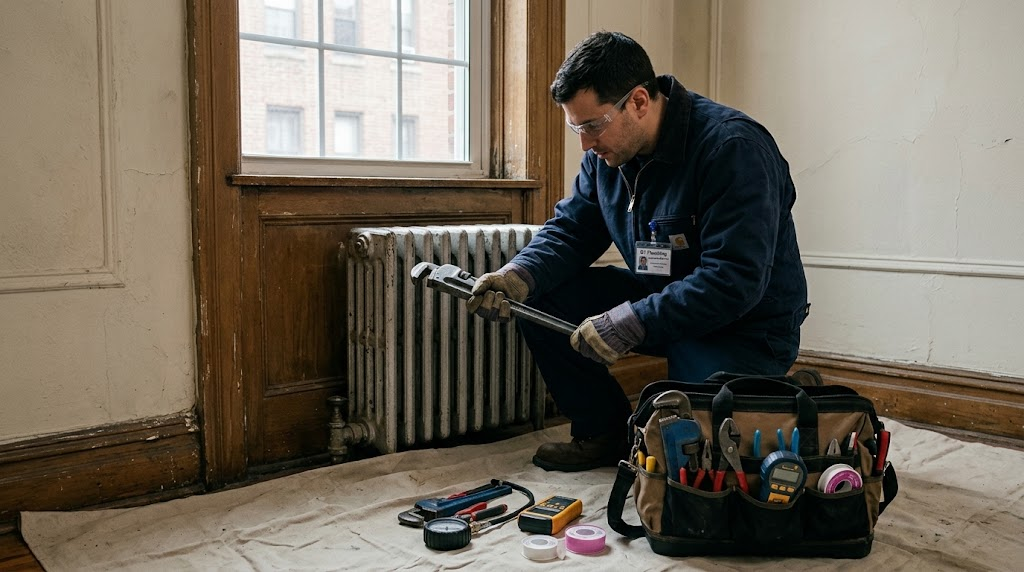
Resolving Banging Steam Pipes (Steam Hammer)
In pre-war residential properties along Grand Concourse, East 188th Street, and Creston Avenue, cast-iron radiators provide substantial heating capacity. However, loud knocking, clanging, and pipe vibrations disrupt indoor peace and signal underlying mechanical imbalance.
Steam hammer occurs when outgoing steam collides with pools of condensed water trapped inside pipes. In a single-pipe steam system, steam and returning condensate water must travel through the exact same pipe in opposite directions. If a radiator is not pitched with a continuous downward slope toward the supply valve, condensate pools in the radiator base, creating violent vacuum collisions when live steam rushes over it.
If your radiator issues occur alongside boiler shut-downs or rapid cycling, explore our guide to boiler repair in Fordham Bronx to check your central system controls.
Air Vent Servicing & System Balancing
Proper steam distribution depends on venting air out of the system before steam can fill the radiators:
- Clogged or Painted Vents: When paint or mineral scale seals the vent orifice, cold air cannot escape, leaving the radiator cold.
- Spitting Air Vents: Worn float mechanisms allowing dirty water or steam to spray onto walls and hardwood flooring.
- Main Line Vents: Failed quick-vents in basement mains preventing steam from reaching building risers quickly.
- Radiator Valve Packing Leaks: Decayed packing washers allowing steam to hiss and leak around the valve stem.
Steam vs. Hydronic Radiator Differences
While steam radiators require open air venting and gravity slope drainage, hydronic hot-water baseboards operate as closed pressurized loops. Cold hydronic convectors typically require manual bleeder valve bleeding to release airlocks.
Radiator Troubleshooting & Balancing Process
Pitch & Slope Alignment Verification
Digital level analysis confirms each radiator maintains a slight pitch toward the supply valve to allow unobstructed gravity condensate return.
Valve & Packing Inspection
Checking supply shut-off valves and union nuts for mineral crusting, packing leaks, and seized valve stems that prevent full opening.
Air Vent Assessment & Sizing
Evaluating radiator air vents and basement main quick-vents, replacing failed units with calibrated orifice vents to balance room warmth.
Operational Firing Test
Running the boiler through an active steaming cycle to verify silent operation, balanced steam arrival, and zero water leakage.
Related Heating & Infrastructure Services
Radiator efficiency is tied to boiler capacity and fuel delivery. Explore our related services:
Central Boiler Sizing: If your radiators stay cold due to an aging or undersized boiler, explore our boiler replacement in Fordham.
Concealed Piping Leaks: If hissing sounds originate from inside walls rather than radiator valves, review our leak detection services in Fordham.
Check our service range across nearby areas on our service areas page, or discuss your heating setup directly via our contact page.
Frequently Asked Questions: Steam Heat & Radiator Repair
What causes loud banging and hammering inside steam heating pipes?
Steam hammer occurs when fast-moving steam encounters trapped pools of cool condensate water. The steam rapidly condenses into a vacuum, causing high-velocity water slugs to crash against pipe walls. This is commonly caused by an improper radiator slope, a partially open shut-off valve, or a stuck air vent.
Why is my cast-iron radiator cold while other rooms are overheating?
In a steam system, steam cannot enter a radiator until air escapes. If the radiator air vent is stuck closed, painted over, or clogged with mineral scale, trapped air blocks steam entry entirely. Replacing and properly sizing air vents balances steam distribution.
Can I adjust heat output by partially closing a steam radiator valve?
No. In single-pipe steam systems, the valve must be either 100% fully open or 100% fully closed. Partially closing the valve restricts returning condensate water while steam tries to force its way in, resulting in violent banging and water spitting from the vent.
Is it safe to tighten a hissing or leaking radiator valve myself?
Do not attempt to tighten or disassemble hot or pressurized radiator valves. Older brass radiator spuds can shear off under stress, releasing scalding steam or pressurized water. Always let a qualified technician evaluate valve packings when the system is cold.
Stop Radiator Clanging & Uneven Heating Today
Get methodical troubleshooting for noisy, leaking, or cold radiators in Fordham and the Bronx. Call NY Plumbing to speak with an experienced technician.